SILENCING THE LENS
By Gloria Chesang
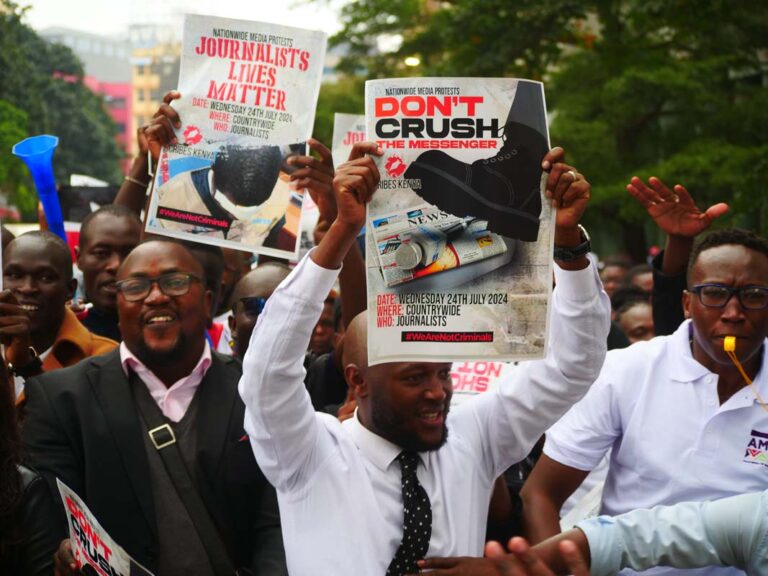
“On whose hands are we safe?” It is a question filled with pain and frustration. The very people entrusted with uncovering the truth and keeping the public informed are increasingly becoming targets themselves.
Journalists do far more than report events. They expose hidden truths, hold those in power accountable, and shine a light on injustices that would otherwise remain unseen. Their work is essential in safeguarding democracy and ensuring the public has access to accurate information.
Sadly, those tasked with protecting citizens are, in some cases, becoming obstacles to press freedom. During recent protests, several journalists carrying out their duties were allegedly assaulted, injured, and even shot at despite clearly identifying themselves with official press credentials. Such incidents raise serious concerns about the safety of media practitioners in Kenya.
One incident that particularly shocked many was the shooting and injury of TV journalist Catherine Wanjeri while she was covering the protests.
Despite being visibly identifiable as a member of the press, she became a victim of violence. Unfortunately, her case is only one among many attacks against journalists in the line of duty.
Another incident that has further highlighted the dangers journalists face occurred on October 20, 2026, involving Citizen TV journalist Francis Odee. The journalist was arrested while covering demonstrations against rising fuel prices along Kimathi Street in Nairobi’s Central Business District on Mashujaa Day.
Despite identifying himself as a journalist and displaying his press identification, Odee was reportedly confronted and roughed up by plainclothes police officers. Videos of the incident showed officers dragging him along the street before bundling him into a police vehicle. His clothes were reportedly torn during the arrest, and he was taken to Central Police Station alongside other individuals who had been arrested during the demonstrations.
Recounting his experience after his release, Odee revealed that he feared for his life while in police custody. His fears were heightened by the fact that he was being held at the same police station where teacher and blogger Albert Ojwang had died while in custody. He questioned what could happen to him as a journalist, especially considering that he had previously reported on cases involving individuals who had suffered in police custody.
His arrest attracted condemnation from various media organisations, including the Kenya Editors Guild and the Crime Journalists Association of Kenya, which called for accountability and investigations into the incident. The Independent Policing Oversight Authority (IPOA) also launched investigations to establish the circumstances surrounding his arrest and detention. The National Police Service’s Internal Affairs Unit subsequently initiated its own inquiry.
Odee’s experience raises another difficult question about the safety of journalists in Kenya. If a journalist can be physically confronted, arrested and detained while carrying out an assignment, what protection is available to those whose responsibility is to document events and inform the public?
Condemning these attacks has become almost routine, yet little seems to change. This raises a difficult but necessary question. Must journalists continue paying the price for telling the truth?